
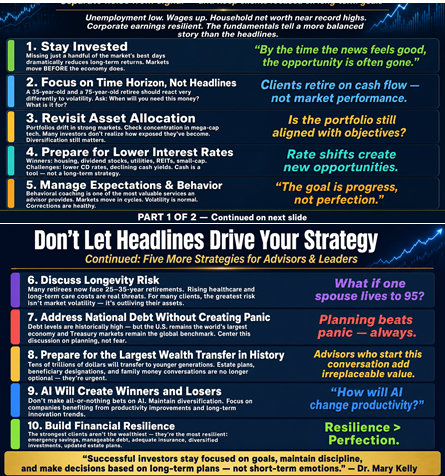
What I Told Financial Planners Last Week: Don’t Let Headlines Drive Your Clients’ Strategy
Mary Kelly Leadership Economist | Keynote Speaker | Conference & Training Programs
The biggest mistake advisors make is trying to predict the next market move. The biggest opportunity is helping clients navigate uncertainty while staying focused on long-term goals.
Right now, clients are hearing a relentless drumbeat of concerns: inflation fears, government debt, geopolitical tensions, AI disruptions, housing affordability challenges, recession predictions. And yet the underlying fundamentals tell a more balanced story. Unemployment remains relatively low, wages have risen substantially, household net worth sits near record levels, corporate earnings have stayed resilient, and the stock market has generated enormous wealth over the long run.
The advisor’s job is to separate noise from signal.
Here’s how:
1. Stay Invested
This is the most important message you can deliver. Historically, missing just a handful of the market’s best days can dramatically reduce long-term returns, yet clients routinely sell during downturns, wait for “certainty,” and re-enter only after markets have already recovered. The problem is that markets move before the economy does.
Remember: “The market is a forward-looking machine. By the time the news feels good, the opportunity is often gone.”
2. Focus on Time Horizon, Not Headlines
A 35-year-old and a 75-year-old retiree should have completely different reactions to market volatility. The right questions to ask your clients aren’t about the market; they’re about the client: When will you need this money? What is it for? What risks truly matter to you?
Clients don’t retire on market performance. They retire on cash flow, income, planning, and discipline.
3. Revisit Asset Allocation
Portfolios drift during strong markets, often without clients realizing it. 2026 is a good time to ask whether the portfolio is still aligned with objectives, whether risk has increased unintentionally, and whether clients have become overexposed to a handful of technology stocks. A large percentage of S&P 500 gains have come from a relatively small number of mega-cap companies, and many investors don’t fully appreciate how concentrated they’ve become. Diversification still matters.
4. Prepare for Interest Rate Changes
If rates continue to moderate, the landscape shifts in important ways. Potential winners include housing, dividend stocks, utilities, REITs, and small-cap stocks. Potential challenges include lower yields on cash, declining CD rates, and reduced income from short-term fixed income.
The key message for clients: cash is a tool, not a long-term investment strategy.
5. Manage Expectations and Behavior
One of the most valuable things an advisor does is behavioral coaching. Many clients expect double-digit returns every year, no volatility, and immediate results. The reality is that markets move in cycles, volatility is normal, and corrections are healthy. Setting those expectations isn’t pessimism; it’s the foundation of a durable client relationship.
The goal is not perfection. The goal is to make progress.
6. Discuss Longevity Risk
This is one of the most significant retirement risks. Many retirees now face 25-to-35-year retirements, rising healthcare costs, and potential long-term care expenses. For many clients, the greatest risk isn’t market volatility; it’s outliving their assets.
The conversations worth having: How much income is sustainable? What happens if one spouse lives to 95? What’s the healthcare plan?
7. Address National Debt Without Creating Panic
Clients are asking about federal debt more than ever, and they deserve a balanced response. Yes, debt levels are historically high, and interest expense is growing, and I frankly worry about the national debt every day. But knowing that the U.S. remains the world’s largest economy, Treasury markets remain the global benchmark, and markets have navigated large debt burdens before helps.
8. Prepare for the Largest Wealth Transfer in History
Tens of trillions of dollars will transfer from older Americans to younger generations over the coming decades. That means estate planning, beneficiary designations, trusts, and family communication are urgent conversations. Many families have never had a meaningful conversation about money. Advisors who facilitate those conversations add irreplaceable value.
9. AI Will Create Winners and Losers
Clients increasingly ask, “Will AI take jobs?” But the better question is: “How will AI change productivity?” Technology has always created disruption and opportunity. Investors should avoid making all-or-nothing bets. Instead, maintain diversification, look for companies benefiting from productivity improvements, and stay focused on long-term innovation trends rather than short-term headlines.
10. Build Financial Resilience
The strongest clients aren’t the wealthiest, they’re the most resilient. Resilient households carry emergency savings, manageable debt, adequate insurance, diversified investments, and updated estate plans. Financial resilience matters more than financial perfection, and it’s something every client can build toward, regardless of where they’re starting.
My One-Sentence Message
“The economy will keep changing, markets will keep fluctuating, and headlines will keep creating anxiety, but successful investors stay focused on their goals, maintain discipline, and make decisions based on long-term plans rather than short-term emotions.”
For business audiences, this message lands beyond finance. The discipline that makes great investors also makes great leaders: have a plan, focus on what you can control, ignore distractions, make decisions based on evidence, and think long term. That’s a message that resonates equally with financial advisors, bankers, business owners, and executives, because it’s really about how good decisions get made under pressure, in any field.
Dr. Mary C. Kelly is a Hall of Fame leadership speaker, PhD economist, retired Navy Commander, and author of 22 books, including Leadership is Tough: What Great Leaders Do Differently.
0 Comments