
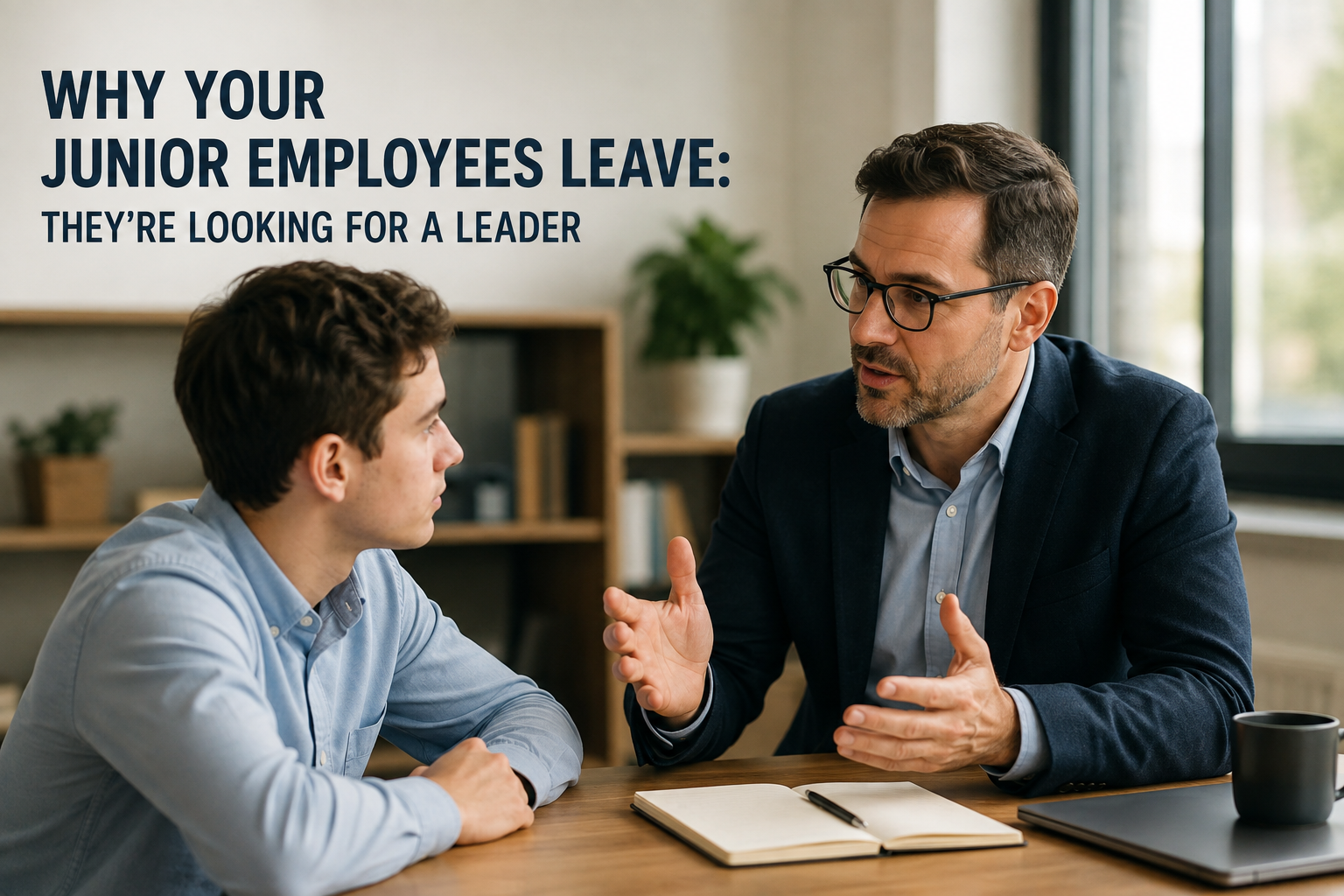
Why Your Junior Employees Leave: They’re Looking for a Leader
Mary Kelly Leadership Economist | Keynote Speaker | Conference & Training Programs
Everyone has heard it. “We hired a great young employee. We trained them. Six months later they left.”
The common response is to blame an entire generation of workers. They’re accused of lacking loyalty, having unrealistic expectations, or constantly looking for something better.
The data tells a different story. Today’s junior employees are leaving organizations because they are not finding what they value most: a supervisor who is willing to invest in their growth.
That is not a generational problem, it is a leadership problem.
The Research Is Clear
Gallup’s workplace research continues to show that employee engagement among workers under 35 has experienced the sharpest decline of any age group. In the United States, employee engagement has fallen to its lowest point in a decade, with only 31% of employees engaged at work. Younger workers have experienced the largest decreases in engagement, and disengaged employees are significantly more likely to be looking for another job.
Meanwhile, Gallup’s 2026 global research found that 52% of employees worldwide believe it is a good time to find another job. In other words, over half the workforce thinks opportunity is somewhere else. That should concern every employer.
Replacing employees is expensive. Gallup estimates that replacing technical professionals costs roughly 80% of annual salary, replacing managers can exceed 200% of salary, and even replacing frontline employees costs approximately 40% of annual pay. Retention is an economic issue.
Development Is Part of Compensation
For decades, organizations competed primarily on salary and benefits. Today they compete on growth.
LinkedIn’s 2025 Workplace Learning Report found that career development has become one of the strongest drivers of employee retention. Organizations that intentionally invest in employee learning, career pathways, mentoring, leadership development, and internal mobility consistently outperform those that do not. The report argues that managers must become “career champions,” helping employees see a future inside the organization instead of outside it.
This is particularly important for younger professionals. Many entered the workforce during enormous disruption. They experienced COVID, inflation, rapid technological change, AI-driven workplace transformation, and organizations that flattened management layers while reducing opportunities for coaching. Instead of assuming loyalty, leaders must now earn it.
AI Has Made Development Even More Important
Artificial intelligence is changing the workplace faster than almost any technology in history.
Many of the traditional entry-level assignments that once taught judgment, critical thinking, communication, and decision-making are disappearing. Young professionals have fewer opportunities to “learn by doing.” That means supervisors must intentionally create those learning experiences.
If organizations fail to replace lost developmental opportunities with coaching, mentoring, stretch assignments, and meaningful feedback, they risk creating an entire generation of employees with technical skills but limited leadership experience.
As AI handles more routine work, human leadership becomes even more valuable.
What Younger Employees Actually Need and Want
Contrary to popular belief, younger employees are not asking supervisors to become therapists or best friends. They are asking for leaders who care enough to help them succeed. That includes:
- Regular coaching conversations instead of annual evaluations.
- Honest feedback delivered with respect.
- Opportunities to build new skills.
- Visible career pathways.
- Stretch assignments that build confidence.
- Mentors who share experience.
- Leaders who explain not only what to do, but why it matters.
These are not expensive benefits, they are leadership behaviors.
Supervisors Make the Difference
For decades, Gallup has found that managers account for the majority of the variation in employee engagement. Employees don’t quit organizations. They quit supervisors.
Unfortunately, many supervisors have never been taught how to develop people. They were promoted because they were outstanding individual contributors, not because anyone taught them how to coach, mentor, communicate, or develop future leaders.
Gallup’s recent research found that only 44% of managers globally report receiving formal management training. At the same time, younger managers themselves are experiencing some of the steepest declines in engagement. That creates a dangerous cycle. Underdeveloped managers struggle to develop young employees. Young employees leave. Organizations promote new supervisors. The cycle repeats.
Great Leaders Build Futures
The best supervisors understand that every conversation is either increasing or decreasing an employee’s commitment.
Every coaching session tells an employee: “I see potential in you.”
Every developmental assignment communicates: “I believe you’re capable of more.”
Every mentoring conversation answers one of the biggest questions young professionals ask themselves: “Can I build a future here?”
If the answer is no, they will eventually answer yes somewhere else.
The Leadership Challenge
Developing younger employees is no longer optional. It is one of the highest-return investments any supervisor can make. Organizations that intentionally develop people experience stronger engagement, better retention, deeper succession pipelines, and higher productivity.
The organizations that fail to do so will continue asking why talented young employees keep leaving. The answer is usually standing in front of the mirror. The next generation doesn’t simply need a manager. They need a leader who believes in their future before they do.
Learn more: https://younextnow.com/
Dr. Mary C. Kelly is a Hall of Fame leadership speaker, PhD economist, retired Navy Commander, and author of 22 books, including Leadership is Tough: What Great Leaders Do Differently.
0 Comments