
Mary Kelly Leadership Economist | Keynote Speaker | Conference & Training Programs
People often ask me how highly successful leaders seem to accomplish so much.Do they have better assistants? More resources? Longer workdays? Usually not.
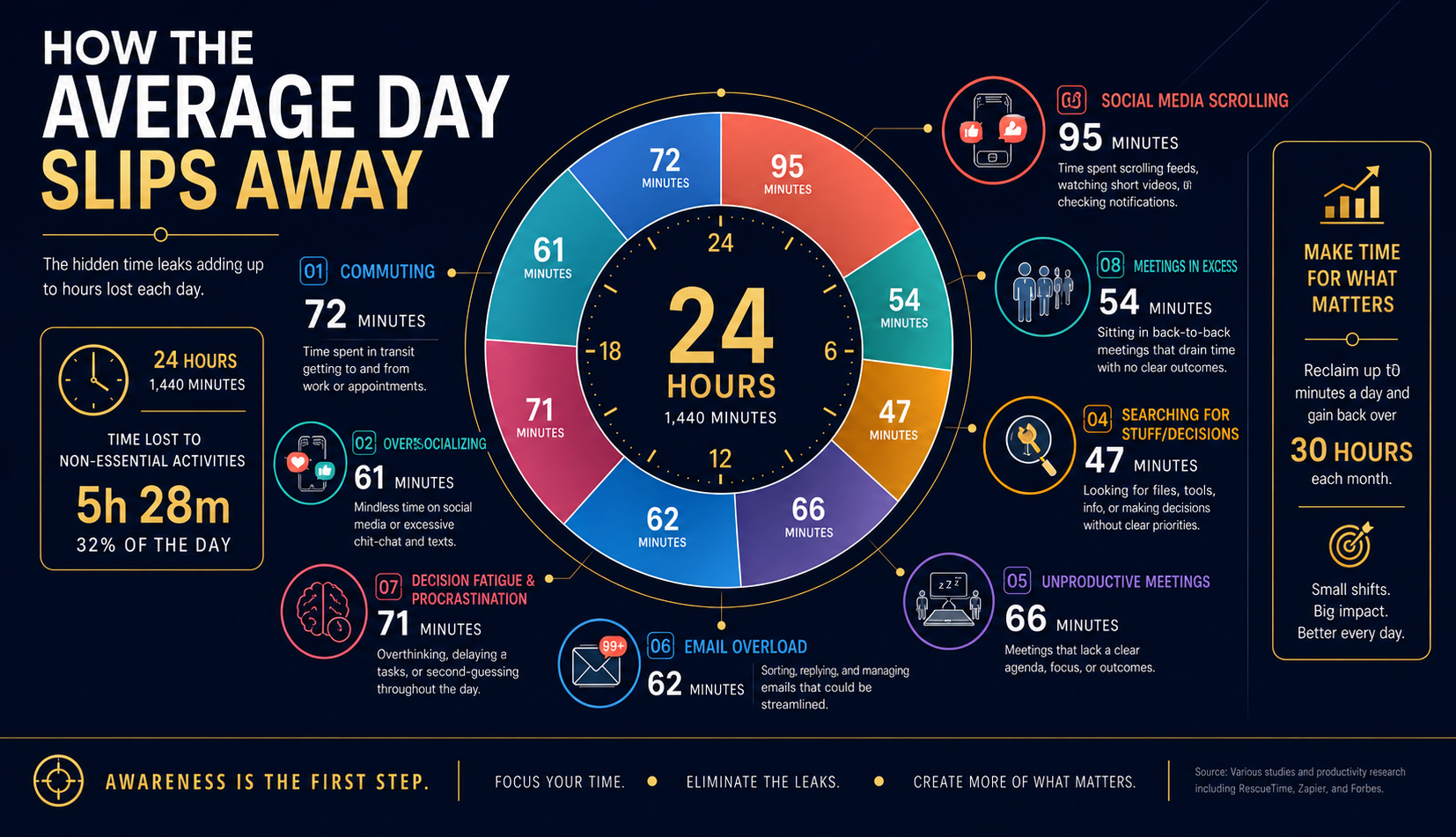
They simply lose less time. Most people don’t waste an entire afternoon. Instead, they lose five minutes here, ten minutes there, another fifteen somewhere else, until they have unknowingly surrendered two or three productive hours. Those lost hours become lost days. Those lost days become lost years.
The good news is that almost every one of these time wasters can be eliminated.
Stop doing these!
1. Starting the Day Without a Plan
If you don’t decide what matters first, someone else will.
Email, text messages, and other people’s emergencies quickly become your priorities.
Begin every day knowing your top three objectives.
2. Checking Email Constantly
Your inbox is someone else’s to-do list.
Every time you stop to check email, you interrupt your own momentum.
Schedule specific times to process email instead of reacting to every notification.
3. Keeping Notifications Turned On
Every buzz, ding, vibration, and pop-up steals your attention.
Most notifications are conveniences—not emergencies.
Turn off everything that doesn’t require an immediate response.
4. Multitasking
Multitasking doesn’t save time, it simply creates more mistakes.
Focus completely on one important task before beginning another.
5. Attending Meetings Without Purpose
Never attend a meeting unless there is a clear objective and you genuinely need to be there.
Ask before every meeting: “What decision are we making?”
6. Holding Meetings That Last Too Long
Meetings tend to expand to fill the time available.
A meeting scheduled for sixty minutes often could have been completed in twenty.
7. Looking for Information
Searching for documents, passwords, notes, receipts, or files wastes enormous amounts of time.
Develop simple organizational systems. Future you will be grateful.
8. Waiting Until You’re Motivated
Motivation is unreliable. Discipline is dependable. Successful people begin before they feel like it.
9. Perfectionism
Perfection is expensive. Often the final five percent of improvement requires fifty percent more effort. Know when excellence is enough.
10. Procrastinating Difficult Conversations
Avoiding conflict usually makes it bigger. Have the conversation. Sooner is almost always easier than later.
11. Making the Same Decisions Repeatedly
Every unnecessary decision consumes mental energy. Create routines. Use checklists. Automate recurring tasks. Protect your decision-making capacity.
12. Doing Work Someone Else Should Do
Many leaders become bottlenecks because they refuse to delegate.
If someone else can perform the task at 80 to 90 percent of your level, let them. You’ll both improve.
13. Saying Yes Too Often
Every “yes” is also a “no.” Every new commitment costs time that cannot be spent elsewhere. Protect your calendar.
14. Solving Everyone Else’s Problems
Good leaders develop problem-solvers.
Poor leaders become professional firefighters.
Instead of immediately giving answers, ask: “What do you recommend?”
15. Switching Between Projects
Every transition requires your brain to reorient itself. Group similar tasks together whenever possible.
16. Wasting Wait Times
Airports. Doctor’s offices. Traffic. Sports practices. Conference breaks.
These moments accumulate into dozens of hours every year.
Carry a book. Review notes. Make phone calls. Think strategically. Use the margins of your day.
17. Social Media That You Think is “Just for a Minute”
Five minutes becomes twenty. Twenty becomes an hour. If social media is necessary for work, schedule it. Don’t drift into it.
18. Clutter
A cluttered desk often reflects a cluttered workflow. Spend a few minutes each day putting things back where they belong. Order saves time.
19. Not Taking Care of Yourself
Fatigue slows thinking. Poor nutrition reduces concentration. Lack of exercise decreases energy. Sleep deprivation increases mistakes. Your health is a productivity strategy.
20. Failing to Prepare
Walking into meetings unprepared creates longer meetings. Beginning projects without planning creates rework. Ten minutes of preparation can save hours later.
21. Repeating Mistakes
Every mistake should teach something.
Ask after every project: “What worked?” “What didn’t?” “What will we do differently next time?” Learning compounds.
22. Avoiding Technology That Saves Time
Some people spend hours doing work that software could complete in minutes.
Learn the shortcuts. Use templates. Leverage artificial intelligence appropriately. Automation frees time for thinking.
23. Trying to Do Everything Yourself
The highest-performing leaders build capable teams. Teaching someone today saves countless hours tomorrow. Delegation is an investment, not a burden.
24. Forgetting Your Long-Term Goals
Busy isn’t the same as productive.
Every week ask yourself: “Did I move closer to my most important goal?”
Activity without direction leads nowhere.
25. Never Stopping to Evaluate Your Time
The biggest time waster of all is never asking where your time actually goes.
Track your activities for one week. Every 15-minute block and be ruthlessly honest. You may be shocked. Most people discover they spend far more time reacting than creating, maintaining than improving, and working in the business rather than on the business. Awareness is the beginning of change.
Time Is Your Greatest Asset
We often think of time management as squeezing more work into the day. That’s backwards.
The goal isn’t to become busier. The goal is to become more intentional.
Highly successful people aren’t necessarily more intelligent. They aren’t necessarily more talented. But they are usually more deliberate about how they spend the one resource that can never be replaced.
Imagine reclaiming just one hour every workday. That’s five hours every week. More than 250 hours every year. The equivalent of more than six full workweeks. Those six weeks could become six weeks with your family. Six weeks writing a book. Six weeks growing your business. Six weeks improving your health. Six weeks developing future leaders.
You don’t need more time. You simply need to stop mindlessly giving it away.
Because in the end, the quality of your life is determined not by how busy you are, but by how wisely you invest the hours you’ve been given.
What are your favorite time savers?
Dr. Mary C. Kelly is a Hall of Fame leadership speaker, PhD economist, retired Navy Commander, and author of 22 books, including Leadership is Tough: What Great Leaders Do Differently.
I am sending this to every employee as this is our busiest time of our selling season. Points 2, 4, 7 and 15 are killers for our team this time of the year.
Our clients want everything now. I make a “to do” list and go in the order of receipt to get things accomplished.
Hi Steve! Thank you so much for sharing. Hope the article will be helpful to your team.