
New Technology Scams Are an Economic and Leadership Crisis
Mary Kelly Leadership Economist | Keynote Speaker | Conference & Training Programs
As an economist, I see something that often gets overlooked.
For years, we have viewed scams as unfortunate crimes that happen to individuals. Someone receives a suspicious email, answers a fraudulent phone call, or clicks on the wrong website. Money disappears. The victim feels embarrassed. Life moves on. Except it doesn’t.
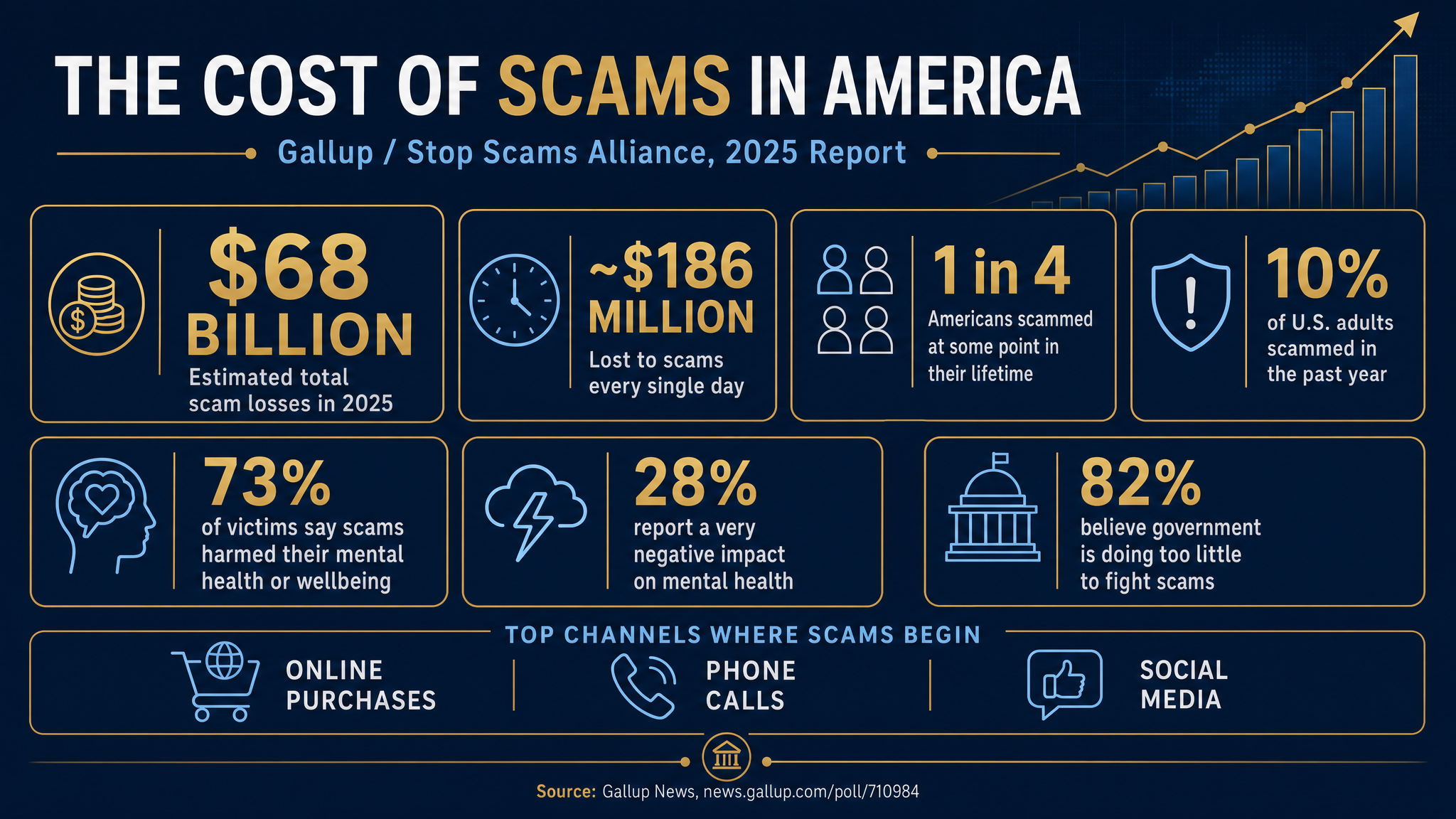
According to Gallup’s new report, Scams in America: How Scams Impact Lives and What Can Be Done About It, scams have become one of the fastest-growing economic threats facing American households. What was once considered a consumer protection issue has evolved into something much larger: an economic challenge, a workforce challenge, and a leadership challenge.
Every dollar stolen by a scammer is a dollar that is no longer available to strengthen the legitimate economy.
That money is no longer being spent at local businesses. It isn’t invested. It isn’t saved for retirement. It isn’t paying down debt. It isn’t creating jobs. Instead, it disappears into criminal enterprises that contribute nothing to economic growth. Multiply that by billions of dollars, and the effects become significant.
Gallup estimates Americans lost approximately $12.5 billion to scams over the past year alone, and losses continue to rise. Many victims lose several hundred dollars. Others lose thousands. Some lose their life savings.
Those losses ripple through the economy in ways most people never consider.
The Hidden Economic Cost
Economists often talk about consumer confidence. When consumers feel secure, they spend. When they feel uncertain, they save more cautiously, delay purchases, and become more risk-averse. Scams directly undermine confidence.
Victims frequently become hesitant to bank online, make purchases, answer phone calls, donate to charities, or trust digital transactions. That reduced confidence slows economic activity.
Scams also disproportionately affect people who can least afford the losses. Gallup’s earlier research found lower-income households and people without college degrees were more likely to report being victimized, making scams an issue of financial resilience as well as criminal activity.
This matters because financially stressed households spend less, borrow more cautiously, postpone major purchases, and often require additional assistance from family members or financial institutions. That’s not just a personal problem. That’s an economic problem.
Financial Stress Walks into the Workplace Every Morning
Leaders sometimes assume that employees leave personal problems at home. They don’t. Financial stress follows people to work. Employees who have been scammed experience:
- Anxiety
- Embarrassment
- Difficulty concentrating
- Sleep disruption
- Lower productivity
- Increased absenteeism
- Reduced engagement
Gallup has long demonstrated that employee wellbeing and engagement significantly influence organizational performance. Financial stress amplifies existing workplace challenges.
Imagine an employee discovering during lunch that thousands of dollars disappeared from a bank account. That person isn’t thinking about taking care of your customers or fulfilling orders or innovation. They’re trying to figure out how to pay their mortgage with what is left in their bank account.
Criminals Are Targeting Organizations, Too
Today’s scammers aren’t simply calling retirees. They’re targeting payroll departments, finance teams, human resources, executives, small business owners, and board members.
Artificial intelligence has made impersonation dramatically easier. Criminals can clone voices, imitate writing styles, spoof email addresses, and create convincing fake invoices in minutes.
The workplace has become one of the primary battlefields. Business email compromise, fake vendor requests, payroll redirection scams, fraudulent invoices, and executive impersonation continue to grow because they work.
The weakest point in cybersecurity isn’t software, it’s human behavior.
Leadership Is the First Line of Defense
This is where leadership matters. Organizations spend millions protecting their technology while spending comparatively little preparing people.
Great leaders recognize that protecting employees extends beyond physical safety. It includes protecting their financial wellbeing. That means creating cultures where people feel comfortable asking, “Does this email seem legitimate?” instead of fearing they’ll look foolish.
It means teaching verification instead of blind compliance. It means slowing down decisions involving money. It means rewarding people who question suspicious requests rather than criticizing them for delaying a transaction.
What Smart Organizations Are Doing
The best organizations are treating scams like any other organizational risk. They:
- Conduct regular scam-awareness training.
- Simulate phishing attempts.
- Require verification for financial transactions.
- Encourage employees to question unusual requests.
- Establish clear reporting procedures.
- Normalize reporting mistakes without embarrassment.
- Include financial wellness in employee assistance programs.
- Educate employees about AI-generated scams.
- Work closely with banks and cybersecurity partners.
- Review internal controls regularly.
Notice that none of these solutions depend solely on technology. They depend on leadership.
This Is Bigger Than Fraud
The Gallup report highlights another troubling finding. Many victims never report scams because they either don’t know where to report them or believe reporting won’t make any difference. That should concern every leader.
Organizations improve when problems are reported. Communities become safer when crimes are reported. Businesses become stronger when mistakes become learning opportunities.
Silence benefits criminals.
Ten Ways to Avoid Being Taken Advantage Of
Whether you’re protecting yourself or your organization, these simple habits dramatically reduce your risk.
- Slow down. Urgency is a scammer’s favorite weapon.
- Verify independently. Never trust contact information provided in the message.
- Think before you click. Hover over links and inspect email addresses carefully.
- Protect personal information. Legitimate organizations rarely ask for sensitive information unexpectedly.
- Use strong passwords and multifactor authentication.
- Question unusual payment requests.
- Talk about scams. Sharing experiences helps everyone recognize warning signs.
- Review financial accounts frequently.
- Report scams immediately to your financial institution and the appropriate authorities.
- Remember that anyone can become a victim. Intelligence doesn’t provide immunity, awareness does.
Leadership Means Helping People
Leadership isn’t only about strategy. It isn’t only about profits. It isn’t only about productivity.
Leadership is about helping people so they can perform at their best. As scams become more sophisticated, organizations that educate employees, strengthen trust, encourage reporting, and build financially resilient workplaces will have a competitive advantage.
Scams are not just a criminal justice issue. They are an economic issue. They are a workforce issue and a leadership issue.
The leaders who recognize that reality today will build stronger organizations tomorrow.
References
- Gallup. Scams in America: How Scams Impact Lives and What Can Be Done About It. June 2026.
- Associated Press. “Americans are inundated with suspected scams. New polling shows why few victims report them.” June 25, 2026.
Dr. Mary C. Kelly is a Hall of Fame leadership speaker, PhD economist, retired Navy Commander, and author of 22 books, including Leadership is Tough: What Great Leaders Do Differently.
0 Comments