
America’s Retirement Savings Reality: The Best Time to Save More Is Now
Mary Kelly Leadership Economist | Keynote Speaker | Conference & Training Programs
Are you saving enough for retirement?
The latest statistics offer both a warning and a reason for optimism. Millions of Americans are behind on their retirement savings, but people who consistently participate in retirement plans are making measurable progress. The lesson is not that retirement security is impossible. It is that retirement security rarely happens accidentally.
Census Bureau data in 2023 showed that 61.5 percent of American households owned a retirement account, which means nearly four in ten did not. For households that had retirement accounts, the median value was $82,000. U.S. Census Bureau
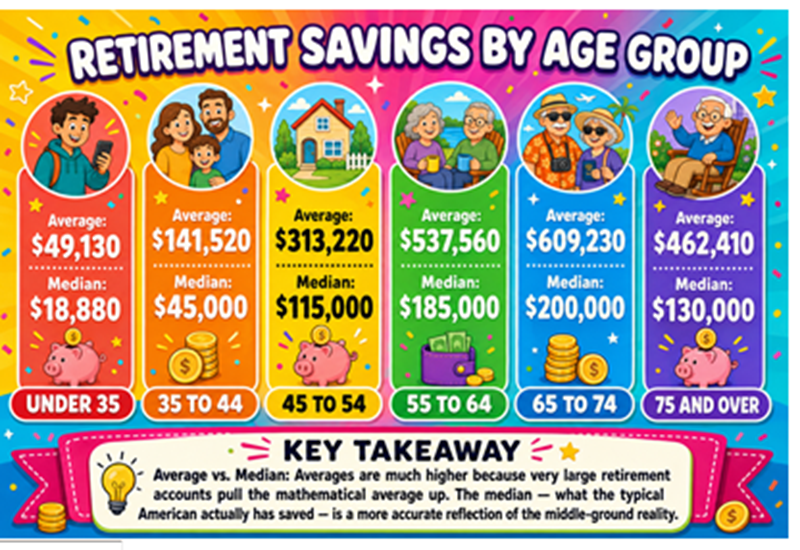
That $82,000 is important because the median—the midpoint at which half have more and half have less—often provides a more realistic picture than the average. A relatively small number of exceptionally large accounts can pull the average upward and make Americans appear better prepared than they actually are.
There Is Encouraging News
Americans who participate consistently in workplace retirement plans are demonstrating that steady action works.
Vanguard’s 2026 analysis of approximately five million defined-contribution plan participants found that the average account balance reached $167,970 at the end of 2025, an increase of 13 percent in one year. The median balance rose 16 percent to $44,115. Vanguard also reported that 45 percent of participants increased their savings rate during 2025, helping lift the average total contribution rate—including employer contributions—to a record 12.1 percent of pay. Vanguard
Fidelity’s first-quarter 2026 analysis produced additional evidence of long-term progress. Although market volatility caused balances to decline from the previous quarter, the average 401(k) balance was $141,000, up 11 percent from a year earlier. The average 403(b) balance was $130,000, up 13 percent, while the average IRA balance was $131,380, up 7 percent. Fidelity Investments
These figures do not mean that every participating worker has accumulated six figures. They do, however, show what happens when people continue contributing through economic expansions, recessions, political uncertainty, inflation, and market volatility. Consistency matters.
Retirement Confidence Is Declining
The 2026 Retirement Confidence Survey from the Employee Benefit Research Institute found that only 61 percent of workers were confident they would have enough money to live comfortably throughout retirement, down six percentage points from 2025. Retiree confidence declined five points to 73 percent.
The same survey found that fewer than three in five workers believed they had enough savings to handle an emergency expense. This matters because inadequate emergency savings frequently force people to reduce retirement contributions, borrow from retirement accounts, or withdraw money early. Employee Benefit Research Institute
Retirement accounts should be treated as long-term assets, not convenient emergency funds. Building a separate cash reserve can help protect retirement savings when the car breaks down, the roof leaks, or employment is interrupted.
Five Actions That Can Change Your Future
First, contribute enough to receive your employer’s full match. If an employer offers matching contributions and you do not claim the entire match, you are leaving part of your compensation behind.
Second, increase your contribution by one percentage point right now. A small automatic increase is less intimidating than attempting to overhaul the household budget. Consider increasing it again in a year or whenever you receive a raise.
Third, make retirement saving automatic. Money transferred before it reaches the checking account is less likely to be spent.
Fourth, avoid comparing your balance with a national average. Your appropriate target depends on your age, income, desired retirement lifestyle, pension eligibility, health, debt, and expected Social Security benefits. Compare your progress with your own retirement goal.
Finally, use the tax-advantaged space available to you. For 2026, employees may contribute as much as $24,500 to most 401(k), 403(b), and governmental 457 plans. The general catch-up contribution for eligible workers age 50 and older is $8,000, while workers ages 60 through 63 may qualify for a higher catch-up contribution of $11,250. The 2026 IRA contribution limit is $7,500, with an additional $1,100 available to eligible people age 50 and older. Internal Revenue Service
Retirement saving is an act of leadership. It requires us to trade a little consumption today for greater independence, flexibility, and dignity tomorrow. Start where you are. Increase what you can. Protect what you accumulate. Most importantly, begin now—because time and compounding can accomplish what last-minute panic cannot.
Dr. Mary C. Kelly is a Hall of Fame leadership speaker, PhD economist, retired Navy Commander, and author of 22 books, including Leadership is Tough: What Great Leaders Do Differently.
0 Comments