

Beyond the Basics: Better Ways to Communicate with Clients (Even When You Think You’re Already Doing It Well)
By Dr. Mary Kelly, Economist, Leadership Strategist, and Author of Stop Procrastinating Tomorrow
We have all heard it: “Communication is key.” And if you are like most professionals, you are probably thinking:
“We send the monthly updates. We return calls. We answer questions. We are doing fine.”
But here is the truth: Fine is forgettable.
When people are short on time, feeling rushed, and the inbox is constantly full, client communication is not just about staying in touch, it is about staying relevant, trusted, and top of mind. It is not just the frequency of the message that matters. It is the quality of the connection.
Here is the kicker. Even when clients say they are satisfied, they may still feel disconnected. In fact, 68% of clients who leave a business say it is because they felt “unappreciated” or “ignored,” not because of price or performance. ¹
Let us go beyond just doing a good job. Let us create client communication that deepens loyalty and drives growth.
Why Great Communication Can Still Fail
Even well-intentioned communication can fall flat when:
- It is too transactional. Here is your invoice. Here is your delivery. Here is your contract.
- It is too infrequent. They reach out when there is a problem… or when it is renewal time. (This is like your teenagers only talking to you when they want the car keys.)
- It is too generic. Dear valued customer means you have no idea who is on the other end, and you do not care.
- It lacks emotional engagement. Are you connecting? Addressing a problem? Showing that you are thinking of them?
You might not be doing anything wrong, but you are also not doing anything memorable.
7 Smarter, More Strategic Ways to Communicate with Clients
1. Use Voice, Not Just Text
Do not underestimate the power of a short voice memo, a quick call, or a personalized video message.
Hearing your voice builds trust and adds warmth. Lots of people really like video messages. I do not, because I am often reviewing emails in airports, so the sound is not going to work, but lots of people love getting personalized videos.
🎙 Tools to try: Loom, BombBomb, the Voice Memos app, or even a selfie video sent via email or text.
2. Send Before They Ask
Proactive communication signals that you are thinking ahead. Whether it is a trend report, an article, or a brief check-in, sharing unprompted updates shows leadership.
💡 “Hey Jamie, I saw this article on hiring trends and thought of you. Hope all is well!”
Simple. Effective. Relationship-building.
3. Share a Win, And Make It Back to Them
Clients like hearing your wins, but they love understanding how those wins benefit them.
📝 Instead of: “We just expanded our office!”
Try: “Thanks to your support, we’ve grown to better serve clients with faster response times.”
4. Add a Non-Business Touch Point
Send birthday cards. Celebrate a promotion. Congratulate their child on graduating. These moments matter.
💌 What I do:
I send handwritten postcards. I choose a photo I love, maybe my dog, a friend’s dog, or a meaningful quote and have it printed on blank postcards. Then I write a short, heartfelt message and drop it in the mail. My rule is, “would I send this postcard to my mom? If the answer is yes, then I can send it to a client.
Mary’s note: If you email me send me your mailing address at Mary@ProductiveLeaders.com, I will send you a postcard to show you what I mean.
People like receiving something that is personal, tactile, and joyful. It shows you are thinking about them as people, not just as accounts.
5. Create a Feedback Loop (and Actually Use It)
Ask for insights. But go beyond boring surveys. Try:
- What is one thing we could do better this quarter?
- What do you wish we did more often?
- How can we be an even better partner for you?
Then implement what they share and let them know:
“You mentioned X—so we’re trying Y.”
It shows you listen, and more importantly, that you act on what they tell you.
6. Establish a Consistent Client Touch Point Schedule
Avoid out of sight, out of mind. Create a rhythm.
I have a newsletter that goes out every week (because I have an awesome team of Johnna, Valerie, and Mika!) who make it all pretty and properly formatted. Here is a secret. I work really hard on these articles. I try to make them helpful, informative, and filled with free tools and the kinds of materials I want in my day-to-day life. And we hope people read the articles. But mostly, I just do not want you to unsubscribe. I want to stay in your email once a week just to say “Hi!” and I hope you remember us. I have people who say they use these articles every week in their weekly meetings and that THRILLS me. I want to be viewed as being helpful.
- Monthly value-added emails
- Quarterly check-in calls and webinars
- Annual review meetings
- Surprise thinking of you gestures.
Predictable connection builds client confidence—even when there is nothing urgent happening.
7. Tell Them What’s Changing Before They Notice
Clients need to be in the information loop. Share updates before they hit their inboxes unexpectedly.
“We’re piloting a new product next month, and I’d love your feedback as one of our best clients.”
Now they are not just informed—they are involved.
What Clients Really Want: The Psychology of Connection
Clients want to feel:
- Seen. You recognize their unique challenges.
- Valued. You care beyond the transaction.
- Safe. They trust you have things handled, even when they are not directly involved.
This goes far deeper than good business practice, it is rooted in human psychology. Research in behavioral economics and organizational psychology confirms that people are more likely to stay loyal to brands and businesses that make them feel emotionally connected.² In fact, emotionally connected clients are over 50% more valuable on average—they buy more, stay longer, and refer others.³
Why? Because people do not want just a vendor or provider. They want relationships. They want to work with people they like, trust, and believe. That means that every touchpoint is a chance to reinforce connection, not just deliver information.
We are wired for trust, empathy, and belonging. When your communication reflects those values, it transforms your business from being useful to being indispensable.
Yes, your product or service matters. But your relationship is what keeps clients coming back.
Everyone’s Busy—That is Why You Communicate Anyway
You are busy. They are busy. But communication is not about time, it is about intention.
Voice notes. Emails. Check-ins. Postcards with pictures of dogs. These are the signals that tell your clients,
“You matter to me. I am thinking about you. I am here.”
If you are already doing a good job? Great. Now let us make it extraordinary.
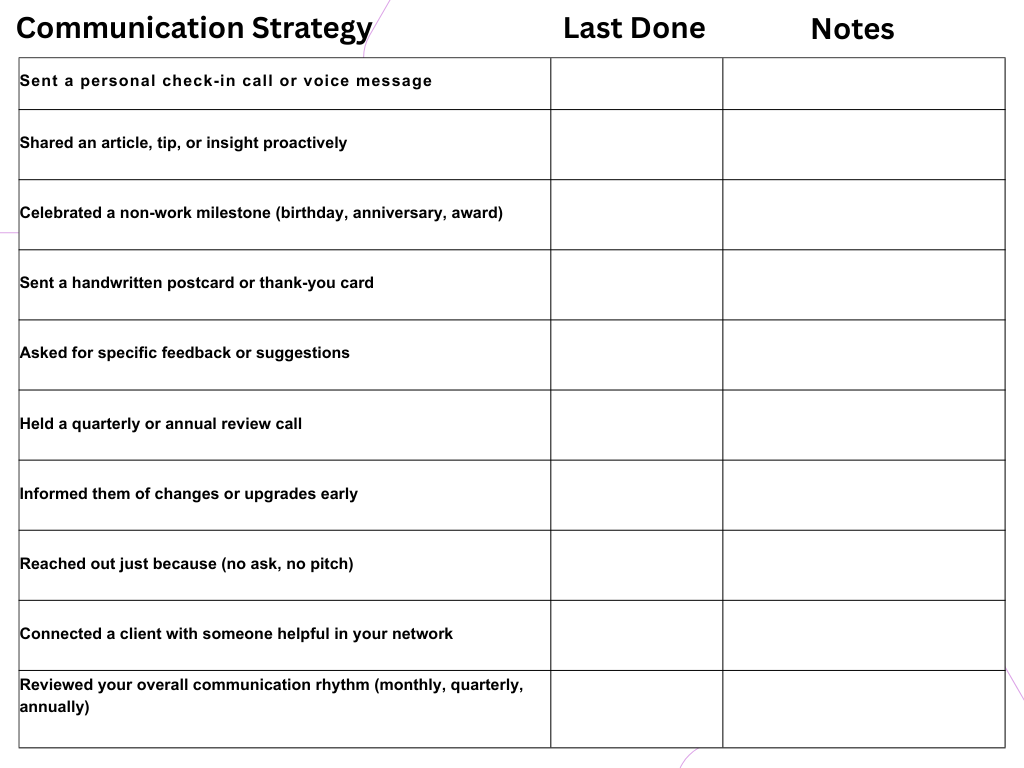
Client Communication Checklist: Going From Good to Great
Use this list quarterly to evaluate and elevate your client communication game.
0 Comments